

On Thursday 5 November, at the third Resilience Breakfast during the Klimaattop Gebouwde Omgeving (Built Environment Climate Summit) at the Jaarbeurs in Utrecht, Michel Scholte presented the Weerbaarheidskompas (Resilience Compass): a five-step method to protect what matters. He did so together with Simon Dikker Hupkes, non-fiction editor at Atlas Contact, which will publish the book of the same name in February 2027. Straight afterwards, Eltjo Bouwman of Blauwhoed showed how the compass is now being applied in a real development: a new, resilient residential neighbourhood near the Jaarbeurs in Utrecht. The book is now available for pre-order.
The Resilience Compass: an emergency kit on paper
Resilience is the core skill of our time. Too important to leave to politicians, too manageable to leave to chance. From the threat of war and cyberattacks to power cuts: the Netherlands is making itself resilient with emergency kits and defence budgets. Necessary, but not enough. How vulnerable our digital chains are became clear again in October: a cyber incident took down Albert Heijn's deliveries, apps and shelf labels for days, and two vulnerabilities in PHP led to DigiD, MijnOverheid and the websites of safety regions being taken offline as a precaution. Michel Scholte shows that we need to embrace a new core skill: resilience. And that it can be learned, like reading or arithmetic, at home and at work.
The Resilience Compass offers one method in five steps: identify, signal, alert, fortify and evolve, ISAFE for short. At its heart is positive resilience, which starts from protecting what matters rather than reacting to threats. Whether you are looking for perspective against despondency or have to steer an organisation: the Resilience Compass is a hopeful handbook for an organisation, team, family or city.
Simon Dikker Hupkes called the book an emergency kit on paper: not a bag of candles and tinned food, but the overviews, agreements and choices you need when supplies alone are not enough. Each step of the compass is a compartment in that kit: the contents list (what matters and what does it depend on), the radio (where do you see a disruption coming first), the phone list (who do you call and who calls you), the supplies (which back-ups and alternatives do you put in place) and the expiry date (practising, evaluating and updating).

Applied to a real neighbourhood
Eltjo Bouwman, director of development at Blauwhoed, showed how the compass works in the practice of area development. Near the Jaarbeurs, Blauwhoed is developing a new residential neighbourhood in which positive resilience is the starting point from the very first design. The focus is not on the threat, but on what residents want to protect: their homes, their neighbourhood, local services and the people around them. From there, choices are made that absorb drought, heat and flooding while making the neighbourhood cooler, greener and more social. Resilt supports Blauwhoed with the Compass. Read more about this approach in the project The resilient neighbourhood.
Opening: the partnership and the climate challenge
Bart Geers, business developer for resilience at ROM Utrecht Region, opened the breakfast with an update on the Resilience Partnership: the public-private collaboration in which businesses, institutions and governments work together on positive resilience, organised along the sectors of the Dutch Critical Entities Resilience Act (Wwke).
Diederik Samsom, chair of the Klimaattop Gebouwde Omgeving, spoke about the need to work on climate adaptation against extreme weather. Preventing heat stress is becoming an increasingly important theme, in the city and in the built environment as a whole. Greening can help enormously: green space cools, retains water and makes neighbourhoods more pleasant to live in.

Resilt: the app, the emergency hubs and the plans for 2027
Michel Scholte spoke about Resilt's progress in developing the app that helps businesses, households and communities become resilient: checking outages nearby, mapping risks, courses and an adviser who helps take the five steps of the compass. Through emergency hubs, with pilots in Utrecht, Amsterdam and Bennekom, the approach is rolled out area by area. He also outlined the progress of the Resilience Partnership and the plans for next year: four breakfasts for Chief Resilience Officers, webinars per sector and, on 4 March 2027, Resilience Day, the second edition of the National Resilience Congress. Until 31 December 2026, organisations can still join free of charge as a launching customer.

Panel: prevention is the best insurance
In the panel, chaired by Hajar Yagkoubi (2100), with Celina Kroon, Esther Egeter (a.s.r.) and Michiel van der Grinten, the discussion focused on what resilience actually delivers. The common thread: preventing damage and (climate) disruption is the best insurance you can take out. Celina Kroon, sustainability manager at UMC Utrecht, stressed the need for resilient and sustainable supply chains, so that medication, medical devices and materials remain available when a supplier or route fails. Michiel van der Grinten (Oberon) talked about social resilience and the school as a place to shape it: children, parents and the neighbourhood learn together what to do when things go wrong.
Closing: building leadership
Marinka van der Meer, co-chair of the Chief Resilience Officers Network, closed with a call to join the Resilience Partnership and to build, from within the network, the leadership that resilience needs: executives and professionals who take responsibility for what matters to their organisation and their surroundings. Want to take part? Get in touch.
Order the Resilience Compass
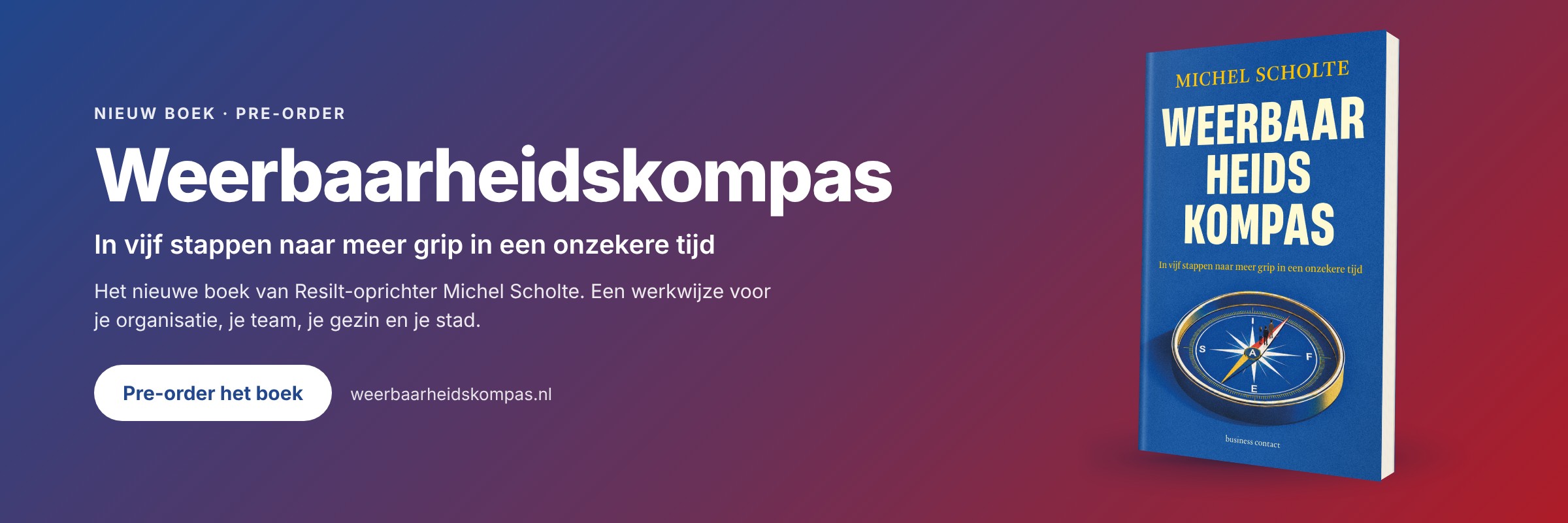
Weerbaarheidskompas (Business Contact, Atlas Contact) is expected in February 2027 and is now available for pre-order. The book is in Dutch. Everyone who pre-orders receives a signed copy and free access to the online introductory course on the Resilience Compass from the Resilt Academy.
Would you like to give the book to your board, team or business relations? Order it in bulk at a discount, with a keynote if you wish. A fine Christmas gift. Request a proposal or contact us through the contact form.
Thanks to the partners
The Resilience Breakfast was organised by ROM Utrecht Region, Blauwhoed, Impact Institute, Resilt and the Klimaattop Gebouwde Omgeving. Thanks to all partners who made this edition possible: UMC Utrecht, ROM Utrecht Region, Blauwhoed, Impact Institute, True Price, 2100, Oberon, the Chief Resilience Officers Network and the Klimaattop Gebouwde Omgeving. And to Atlas Contact, the publisher of the Weerbaarheidskompas. Thanks also to everyone who joined us at the table.