
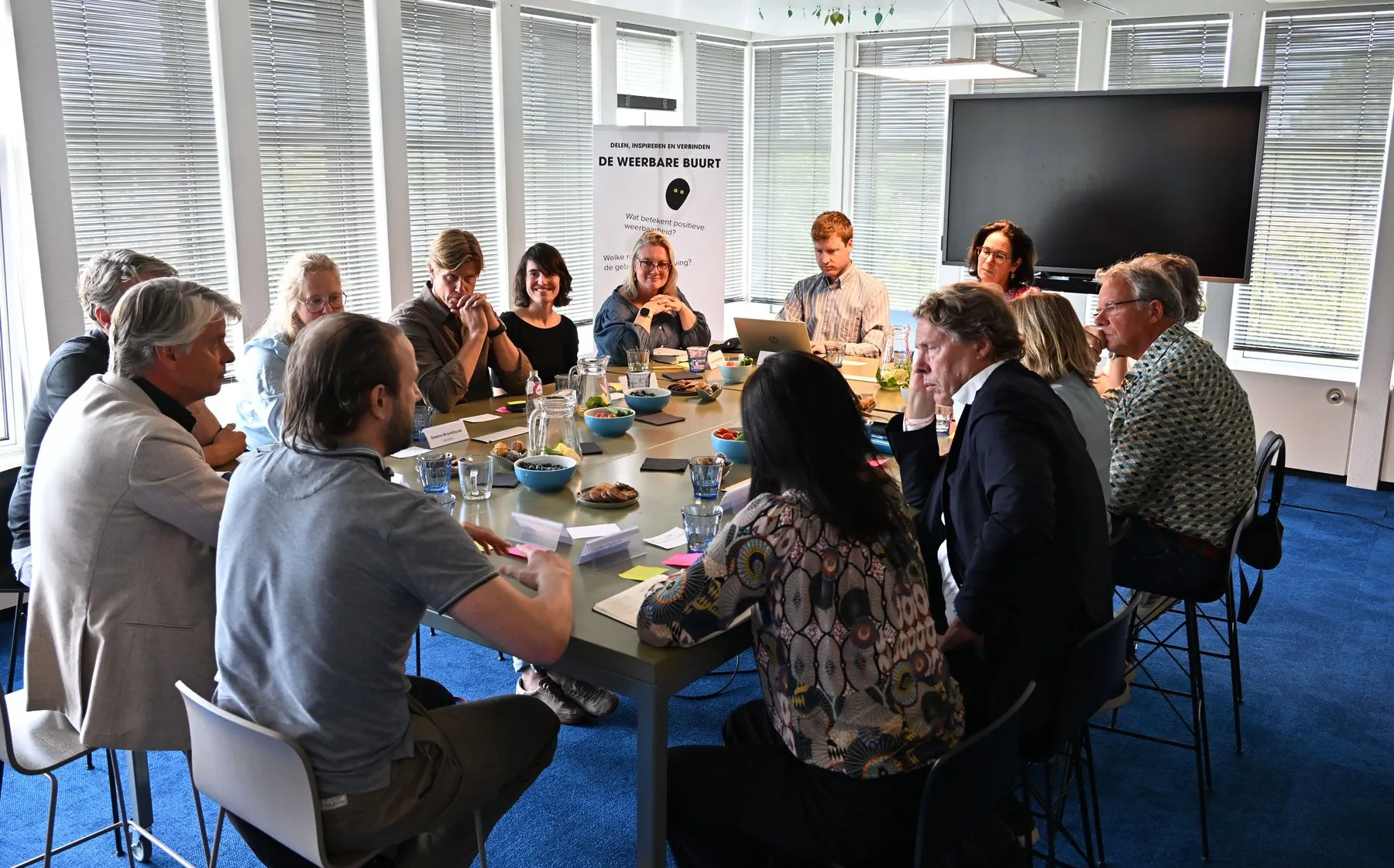
Power cuts, water scarcity and grid congestion are making resilience an increasingly relevant theme in area development. Together with area developer Blauwhoed we sat down at the knowledge table The Resilient Neighbourhood, with experts from construction, finance, care, landscape architecture and research. The conclusion of the afternoon: collective self-reliance belongs in area development from the very start.
Who has an emergency kit at home? Who knows their family members’ phone numbers by heart? And who carries cash? Yvonne van Mierlo, director of Blauwhoed Studio, opened the session with those three questions. The answers immediately showed how self-evident permanent availability has become in the Netherlands.
Resilience is more than crisis management
Anyone looking only at acute crises misses a large part of the task. Ageing, growing inequality and declining social cohesion gradually put the resilience of neighbourhoods under pressure too. Blauwhoed therefore takes a broader view than crisis management: not only averting danger, but above all protecting what people hold dear. Positive resilience, as Van Mierlo calls it. In area development she still sees resilience featuring too little as a theme, while the beginning is exactly where you can set the frameworks.
That is Resilt’s starting point as well. We begin with what you want to protect, and only then with the threat.
From self-reliance to collective self-reliance
The common thread was collective self-reliance, a notion raised by Joan Ronner (Area of People) and one that Hans-Hugo Smit, sector strategist for housing and area development at Rabobank, finds more apt than self-reliance. ‘Our society is strongly geared towards organising your own life individually, while real resilience asks people to look after each other as well.’ Chantal Mies, managing director of Stichting B for You, recognises this: people who are mainly getting through the day have little room to build a network. Shame can deepen that isolation, and good contact with immediate neighbours is already an enormous support.
Social cohesion does not emerge by itself
Anne-Mette Andersen, founder of AM Landskab, challenges the idea that people in vulnerable neighbourhoods automatically depend on one another. Through her work with public health services and others, she sees social cohesion disappearing in some neighbourhoods and loneliness increasing. The classic working-class neighbourhood, where residents shared a similar background and knew each other, has almost ceased to exist.
Architect Joris Deur (ZZDP) therefore asks how area development can encourage encounters in today’s society. He points to courtyards in Amsterdam that often stay locked to avoid nuisance and maintenance costs. A missed opportunity, he argues: you can look at such a place, but you are not using it to bring neighbours together. Gwenn Bronkhorst, fund manager at SECTIE 5, links this to ownership. People who feel co-owners of their living environment are more willing to think along, help others and take responsibility.
Not everything has to work all the time
According to Leontien de Waal, sector expert in construction and area development at ABN AMRO, we still too often design on the assumption that facilities must be permanently available, while area development should leave more room for flexibility and outages. Eltjo Bouwman, development director at Blauwhoed, asked out loud whether an occasional power interruption must always be unacceptable if it makes more housing possible. Masja Cohen, an adviser on social and physical area development in Amsterdam Zuidoost, warned at the same time against tunnel vision on housing numbers: are we still building neighbourhoods that are accessible and liveable for everyone?
No tick-the-box development
The role of the developer prompted debate. Cohen also sees a role for government and for mandatory frameworks. De Waal noted that many requirements are imposed separately, without an integrated view of the eventual area, while integrated thinking is precisely what is needed. Bouwman named the risk of tick-the-box project development: responsibility for a well-functioning neighbourhood does not automatically end at completion. Lise Roodbol, development manager acquisition at Blauwhoed, argues that for new areas you should think in advance about a period in which basic services fail. ‘Without internet and electricity, almost nothing works any more. Make sure essential functions can keep going for a number of hours.’
Making resilience measurable
Technical measures are relatively easy to calculate, while the benefits of social investment sometimes only become visible years later. That, according to Alex Sievers, founder of Beyond Now, is a fundamental challenge: we look mainly at today’s loss, while we should be calculating which social costs we prevent later on. Joan Ronner therefore tries to make social functioning more visible, measuring not just satisfaction with service and bricks, but also a sense of home and social connection.
Michel Scholte, founder of Resilt, has developed a method to make resilience visible and is applying it together with Blauwhoed in a project. ‘First we map the vulnerabilities, from water to wifi.’ Resilt then offers a participation platform for collective self-reliance. ‘In a world of mutual dependencies, resilience does not come from owning or controlling everything yourself, but from understanding, preparing and acting better together.’
What we are doing with Blauwhoed
Blauwhoed is exploring in practice what that can look like, with a project combining homes with social functions: a school, a day-care centre, a gym, hospitality, a shared garden and a communal living room. Functions should complement each other, and the scale of buildings should make it easier to get to know your neighbours. Together with Resilt, we are examining how that set-up can stay resilient over the longer term.
Management matters at least as much as design. Communal spaces are often drawn in but then barely used, Anne-Mette Andersen warns. Joan Ronner therefore sees opportunities in arrangements such as an area-wide owners’ association, in which residents and professional parties share responsibility after completion as well.
The most fundamental infrastructure is between people
At the close of the session, Eltjo Bouwman summarised a key part of the discussion: from a strong social base people can solve physical problems together, while physical interventions on their own solve no social problems. That brings the discussion back to the seemingly simple questions the afternoon began with. An emergency kit, a generator or a shelter can be useful, but the most fundamental infrastructure of a resilient neighbourhood is not underground: it sits between people.
Who was at the table
- Yvonne van Mierlo, director Blauwhoed Studio
- Eltjo Bouwman, development director Blauwhoed
- Lise Roodbol, development manager acquisition Blauwhoed
- Leontien de Waal, sector expert construction and area development ABN AMRO
- Hans-Hugo Smit, sector strategist housing and area development Rabobank
- Masja Cohen, adviser social and physical area development
- Anne-Mette Andersen, founder AM Landskab
- Gwenn Bronkhorst, fund manager SECTIE 5
- Joan Ronner, co-founder Area of People
- Chantal Mies, managing director Stichting B for You
- Joris Deur, architect ZZDP
- Alex Sievers, founder Beyond Now
- Michel Scholte, founder Resilt
Read on and join in
The full account of the knowledge table is available in the Dutch-language white paper De Weerbare Buurt.
Read more about our approach for areas in the project The resilient neighbourhood and on the page about the domains. Would you like to explore what resilience means for your area or project? Send us a message.