
Journalist Gerben Beutick reported on the opening of the first Noodhub at Steenweg 12 in Utrecht.
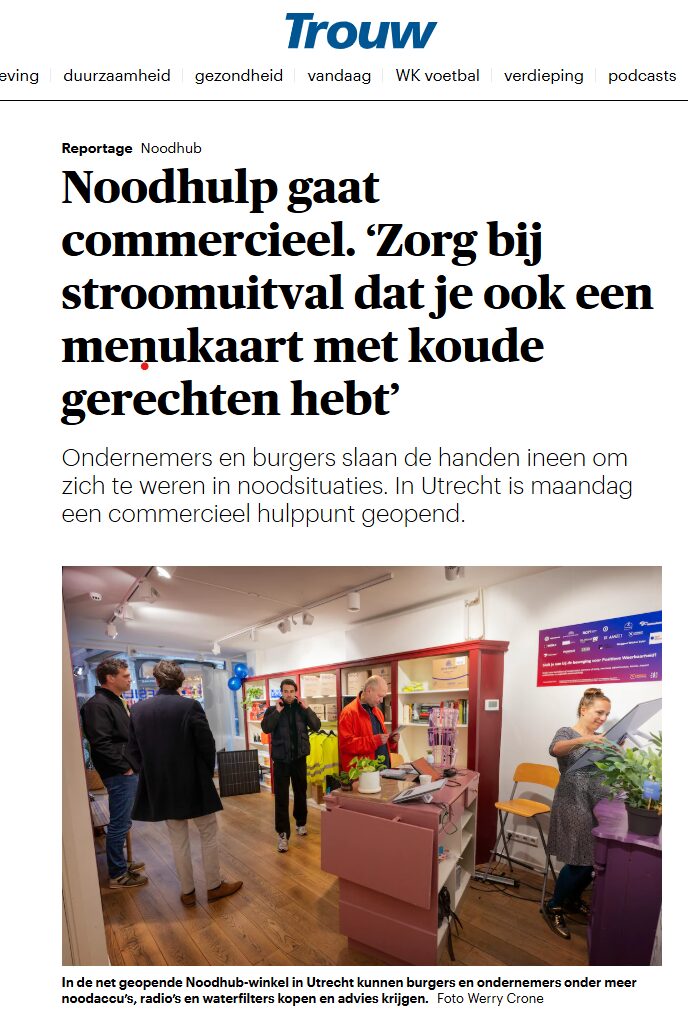
"Business owners and citizens are joining forces to protect themselves in emergencies. A commercial help point opened in Utrecht on Monday.
When a bacteria was found in the drinking water a few months ago, Utrecht restaurant owner Stephen Nieuwenhuis did not know what to do. How long should the water be boiled, for example? He had no idea who to ask. "I called 112, but that was not right."
For crises like these, entrepreneur Michel Scholte opens a 'Noodhub' this Monday. In this shop in Utrecht, citizens and business owners can not only buy emergency batteries, radios, water filters and satellite internet antennas. There is also a dashboard in the shop window showing all kinds of outages and threats. "That information could not previously be found on one portal."
The recent drinking water contamination in Utrecht underlines the need for his help point, according to Scholte. "The shelves of water bottles were empty in no time", he recalls. "Who misses out then? The elderly and other vulnerable groups." Scholte does not understand why there was no central point for help.
Very expensive to arrange everything yourself
More of Scholte's hubs are due to open in other parts of the Netherlands soon. Through the venture, citizens and business owners can invest in their resilience together. By purchasing emergency supplies collectively, Scholte hopes his participants will be better off. "Right now it is very expensive to arrange all of that entirely on your own as a citizen or company."
The shops should also become places where residents and companies can learn from each other. Scholte already has a concrete tip for restaurants when power or gas fails: "Make sure you also have a menu with cold dishes."
Scholte also says explicitly at the opening that his hub is part of his commercial company. "But we try not to profit from crises. At most, we want a fair return on what we do."
Government 'still does too little'
Nieuwenhuis is the first member of the new initiative. "As a business owner I have plenty of other worries on my mind", he says. "Here, fortunately, they know what I should do in unexpected emergencies." He also hopes to get information sooner at the hub during events like that drinking water contamination.
Scholte emphasises that, for now, this is not a collaboration with the government. His shops should therefore not be confused with the trial of local emergency support points, carried out by the national government among others. With that trial, the government wants to assess whether emergency services and citizens can find and help each other during an emergency.
According to Scholte, the government still does too little for the resilience of citizens and business owners. He was triggered by the government's information booklet, titled Prepare for an emergency (Bereid je voor op een noodsituatie). "That was the last straw for me", he says. "Where on earth is this heading?"
Half of all companies do not prepare
Scholte no longer wanted to wait to buy generators, for example, and draw up local crisis plans. "Preparing for emergencies is extremely urgent", he states. "We recently saw how disruptive fires in our forests and in data centres can be."
Harald Hanemaaijer, spokesperson at the Ministry of Economic Affairs and Climate Policy (EZK), says companies are 'quite vulnerable' to emergencies but at the same time are not taking action. 51 percent of companies take no resilience measures at all, according to EZK research.
Hanemaaijer thinks it is a good thing that Scholte is helping citizens and companies to prepare further for emergencies. Some countries are already much further ahead. "In Finland, for example, you see supermarkets being able to share emergency power."
Read the full article at Trouw.