
Michel Scholte, the CEO of Resilt, was interviewed for the Algemeen Dagblad by Peter Schong.
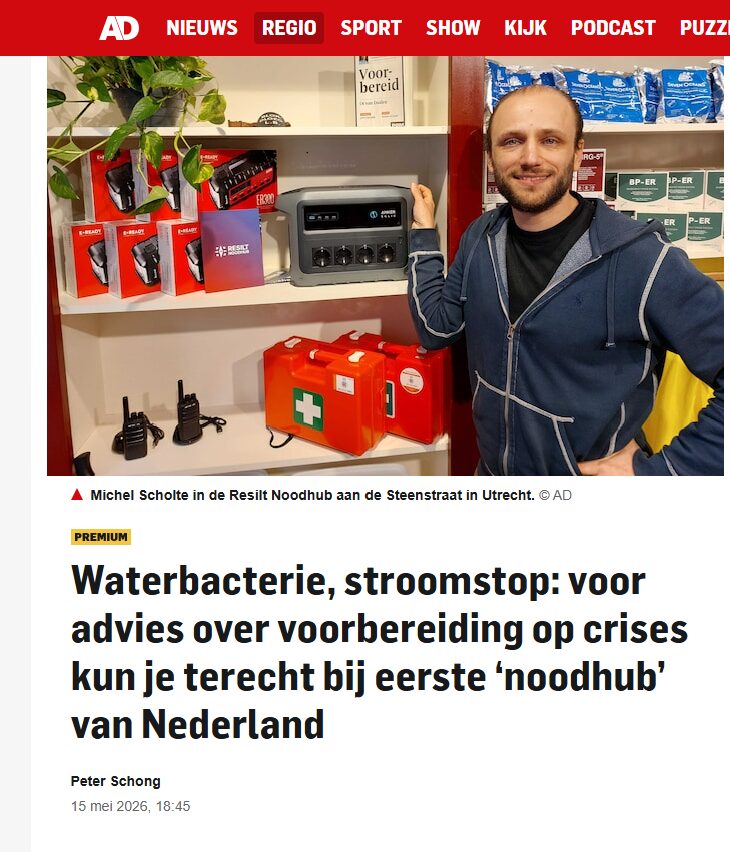
Water bacteria, power cut: for advice on preparing for crises, you can turn to the first 'noodhub' in the Netherlands
Boiling your tap water for days because of a harmful bacteria. A freeze on new connections to the power grid. The university closed because of a fire in a data centre. For the people of Utrecht, these situations have become reality. To prepare business owners well for a crisis, the first Resilt Noodhub in the Netherlands opened its doors this week on the Steenweg.
At the shop, business owners and citizens can get information and advice, but also emergency internet via satellite connection, battery packs, solar panels that generate enough power to run a small office, drinking water, and even gas masks that protect against the smoke of a forest fire. Utrecht has the premiere, but Resilt wants to expand the Noodhubs across the whole country. Collective self-reliance is the motto, explains initiator Michel Scholte.
“The Noodhub is focused on resilience; we focus on preventing, preparing, collective self-reliance. That means we have to act as a collective, together with all business owners and all households. Every home should have a power generator; we want to prevent the biggest emergency batteries from going to the richest companies.”
Take, for example, the water bacteria found in Utrecht last November, Scholte argues. “The supermarket shelves were empty straight away. The people with the fewest resources were left without water. There was no anti-hoarding policy. Shopkeepers can simply raise prices if they want to. There is no guarantee that 'elite water' will not emerge.”
“I do not want to give people bad ideas, but there are more cameras in Hoog Catharijne than at the water extraction area. According to the government we are in a hybrid war; what happens if there are people acting in bad faith? Then we really have a big problem, then we have no water at all. Right now it is every man for himself.”
If business owners or households have generators or emergency internet, these can be shared with each other. - Michel Scholte, Resilt
How do you want to realise that collective self-reliance?
“We can offer discounts on products because we buy collectively. If business owners or households have generators or emergency internet, these can be shared with each other. If a company has a satellite internet station, you can connect ten businesses to it. Or three cafes on one emergency generator, instead of one. Working together instead of every man for himself. We handle that coordination.”
“We also want to jointly reach out to institutions and governments, because it is difficult for the government in The Hague to liaise directly with business owners and households. We want to support the improvement of protocols. For example through one portal where all outage data comes together, instead of fifty.”
Services are not a resource but a 'we source' - Michel Scholte, Resilt
“Grid congestion, for example, is not only a technological issue but also a social issue. If we do not all use power at the same time, that spare capacity can be used smartly. But right now there is no smart place where water companies, power companies and governments talk to each other. They need to start working together smartly, and that is what Resilt does. We want to make the costs bearable with collective purchasing and sharing. Collective self-reliance as a total solution.”
When the government called on citizens to get an emergency kit, critics said this would cause unrest among the population. What do you think of that criticism?
“A lot is coming together now: cyberattacks, the climate problem, energy. It is precisely necessary to help governments and emergency services. We must join forces with business owners and households and work on a resilient society, instead of criticising the government for scaring people. Government, business owners and households need to connect with each other to see who needs what. That is why we are going into the shopping streets. Of course, I am commercial and I want a healthy company with returns and sufficient scale, but with the idea of collective self-reliance, the government is better off too.”
Read the full article at the AD.